SurfLayer is an innovative Web3 protocol designed to simplify and gamify on chain interactions across multiple Ethereum Virtual Machine (EVM) compatible blockchains. Built as a platform for what it calls “on chain rituals”, SurfLayer allows users to build a persistent Web3 identity while unlocking rewards across more than 20 EVM networks.

Unlike traditional protocols focused purely on financial transactions, SurfLayer emphasizes exploration, gamification and multi chain participation. Everyday blockchain actions are transformed into structured, rewarding experiences that encourage users to actively engage with different ecosystems rather than remaining isolated on a single network.
*Advertisement.*
Origin and Core Purpose
SurfLayer was created to address one of the most persistent challenges in crypto: making on chain activity accessible, engaging and rewarding without locking users into one blockchain. Its core mission is to encourage interaction across multiple networks by turning common actions into quests, campaigns and rituals that build a strong and verifiable on chain history.
By participating in SurfLayer activities, users expand their digital footprint across ecosystems such as Arbitrum, Linea, Base, Mantle and BNB Chain. This on chain history can later be used to qualify for rewards, reputation boosts and potential airdrops from partner protocols.
Core Features of SurfLayer
One of SurfLayer’s most important features is its seamless support for on chain rituals across multiple networks. Users can perform actions like swaps, staking, deployments or quest participation without manually switching networks, thanks to integrated cross chain infrastructure.
Another key component is the Surf Points (SP) system. Every eligible interaction generates points that track user activity and engagement. These points are used to unlock rewards, reputation boosts and NFTs, encouraging long term participation instead of one off usage.
SurfLayer also places strong emphasis on Web3 identity. Instead of functioning like a simple wallet dashboard, the protocol allows users to build an on chain profile that reflects their multi chain activity. This profile acts as a digital passport for exclusive opportunities such as NFT access, memecoin launches and ecosystem events.
Key Modules of the Protocol
SurfLayer is structured around three main modules that form the backbone of its ecosystem.
Moongate Campaign
Moongate functions as a launchpad for both fungible tokens and NFTs. Projects can use it to launch brands, memecoins, NFT tickets or membership passes across multiple chains. This module helps projects reach wider audiences while allowing users to participate in launches without leaving the SurfLayer environment.
*Advertisement.*
Quests and Ecosystem Campaigns
This module transforms on chain interactions into guided and gamified missions. Examples include ecosystem quests such as Arbitrum Ecosystem Quest or OPN Testnet Quest. Users complete tasks like interacting with DEXs, bridges or DeFi protocols, earning points and rewards along the way.
Reward Hub
The Reward Hub introduces seasonal incentives and advanced reward mechanics. One highlight is the “two in one” reward model, where actions on one chain may qualify users for rewards on another. This ensures that interactions are part of a broader multi chain strategy rather than isolated activities.
How SurfLayer Works
SurfLayer operates through a multi chain architecture powered by EVM compatible smart contracts. After connecting a wallet such as MetaMask, users access the platform via the official website and begin performing on chain rituals.
For example, a quest may require:
- Executing a swap on a DEX on Base
- Bridging assets to another chain
- Performing a stake or deploy action on Arbitrum
All actions are tracked automatically and converted into points.
Cross chain interactions are supported by aggregators such as LI.FI, which enables efficient and low cost bridging. SurfLayer runs entirely in the browser and does not require additional software installations. It currently supports over 100 EVM networks including Linea, Mantle, Base, BNB Chain and HyperEVM.
SurfLayer also has a native token, SURFLAY, which trades in pairs such as SURFLAY/WETH on Uniswap (Base). This token may be used for governance or internal incentives within the ecosystem.
Benefits and Impact on Web3
SurfLayer lowers the barrier to multi chain participation, making Web3 more approachable for new users while remaining powerful for advanced farmers. Users gain not only financial rewards but also a valuable on chain identity that may help them qualify for future partner airdrops.
For developers and projects, SurfLayer offers powerful tooling to run multi chain campaigns without being limited to a single network. This reduces fragmentation and increases engagement across ecosystems.
Rather than focusing on blockspace scaling alone, SurfLayer focuses on making on chain activity meaningful, connected and rewarding, helping create a more vibrant and interactive Web3 environment.
How to Farm the SurfLayer Airdrop
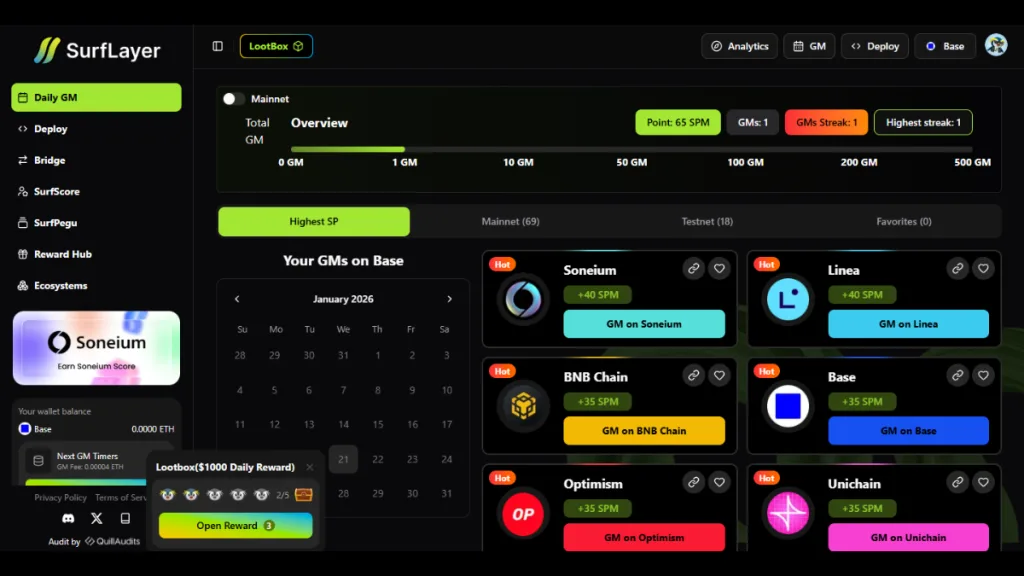
SurfLayer has generated strong airdrop speculation due to its point based reward system. However, there is no official confirmation of a native token airdrop from the team at this time.
The protocol operates through on chain rituals that reward users with Surf Points (SP) and Surf Point Multipliers (SPM). These points are earned by completing quests, opening lootboxes and interacting across multiple networks.
*Advertisement.*
Step by Step: How to Start Farming SurfLayer
1. Open LootBoxes
Opening lootboxes gives you a chance to receive dollar denominated rewards and also grants a random amount of SPM points.
2. Say GM
Sending a “GM” on supported networks earns SPM points depending on the chain used.
3. Deploy
Using the deploy feature allows you to deploy contracts on selected networks and earn between 7 and 25 SPM, depending on the chain.
4. Bridge
Bridging assets between networks also generates points. Since the bridge is powered by LI.FI, this action can simultaneously qualify you for other ecosystem airdrops.
These actions are simple, repeatable and designed to be part of a daily or weekly farming routine.
SurfLayer is a strong option for users looking to farm multiple networks efficiently while building a rich on chain identity. Adding SurfLayer interactions to a daily or weekly farming routine can be effective, especially actions like regular deploys on emerging networks such as HyperEVM.
While an official airdrop has not been confirmed, the structure of the points system, quests and reputation mechanics suggests long term incentive potential. For multi chain farmers, SurfLayer is a protocol worth consistent interaction.
🔗Links
SurfLayer: Official Website
SurfLayer Documentation: Docs
Disclaimer
This is not financial advice. If you decide to interact with the mentioned protocols, you do so at your own risk. Airdrop Guild is not responsible for any potential losses resulting from participation. Always do your own research before engaging with blockchain based projects.